What it is
The Aoi Matsuri is one of Kyoto’s oldest festivals. Its origins go back to the 6th century, when disasters struck the land and the emperor sent offerings to the gods of the Kamo shrines to calm them. In the Heian period it was so famous that “the festival” simply meant the Aoi Matsuri.
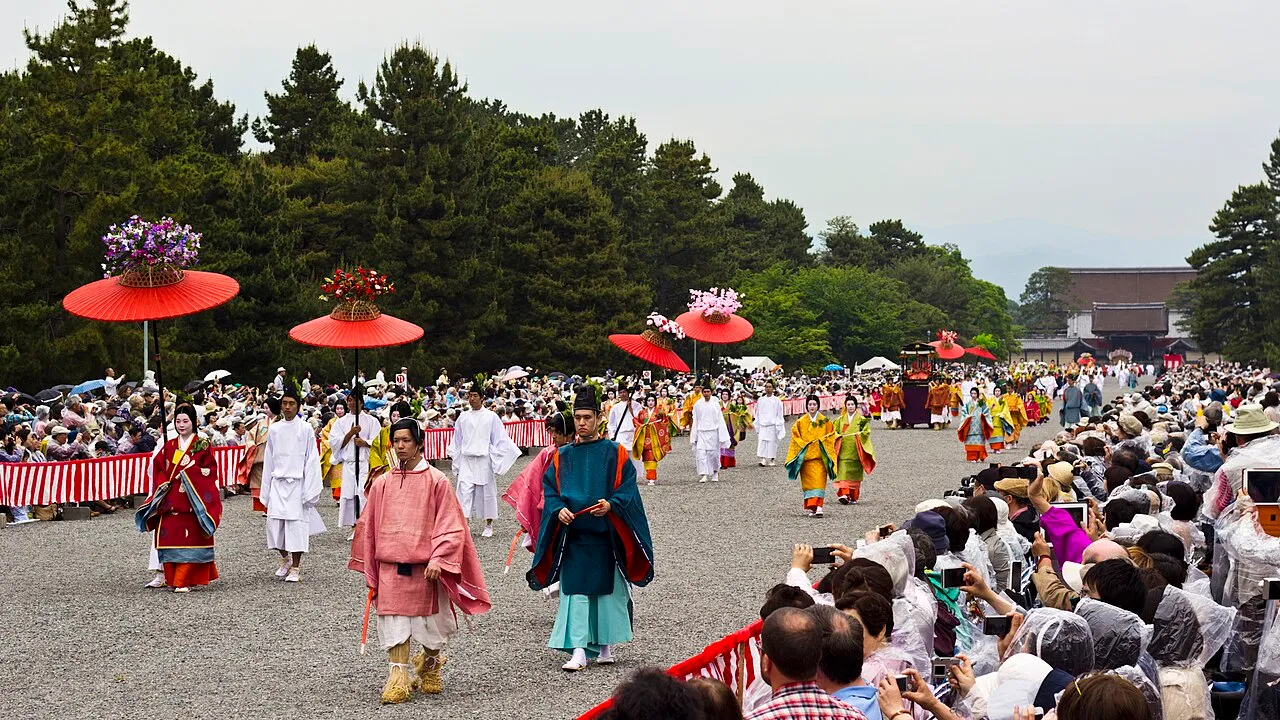
Today the main event is the Rōtō no Gi, a procession of about 500 people in the dress of the Heian court, with horses and an ox cart. It walks from the Kyoto Imperial Palace to Shimogamo Shrine and then on to Kamigamo Shrine, where an imperial envoy presents offerings, just as in the days of the old capital.
The festival at a glance
| Date | What happens |
|---|---|
| Early May | Preliminary rites: Horse races and mounted archery at the Kamo shrines in the first days of May |
| May 15, morning | Procession leaves the Imperial Palace: The Rōtō no Gi procession sets out in the late morning |
| May 15, midday | Shimogamo Shrine: Rites at Shimogamo, then the procession continues north along the Kamo River |
| May 15, afternoon | Kamigamo Shrine: The procession arrives at Kamigamo for the final rites |
Which day should you go?
May 15, at the Imperial Palace
Watch the start from the palace grounds, where the wide gravel paths give clear views. Paid seats are available.
May 15, along the Kamo River
Watch the procession walk under the trees of the riverbank on the way to Kamigamo.
What to look for
The Saiō-dai
A young woman of Kyoto, chosen each year, plays the role of the imperial princess who served the Kamo shrines. She rides in a palanquin in twelve-layered robes.
Hollyhock leaves
Everything from costumes to ox carts is decorated with aoi, hollyhock leaves, sacred to the Kamo shrines.
The ox cart
A lacquered cart pulled by an ox, decorated with wisteria, carries the symbolic presence of the imperial envoy.
Getting there & where to stay
| From | How | Time |
|---|---|---|
| Tokyo | Tōkaidō Shinkansen (Nozomi) to Kyoto Station | about 2 h 15 min |
| Osaka | JR Special Rapid from Osaka to Kyoto Station | about 30 min |
On the day. From Kyoto Station, take the Karasuma subway line to Marutamachi or Imadegawa (about 10 minutes) for the Imperial Palace. The procession then moves north to Shimogamo and Kamigamo shrines.
Crowds. The procession starts mid-morning. Paid seats at the Imperial Palace and Shimogamo Shrine give the clearest view; free spots along the route fill early.
Where to stay
Central Kyoto (Shijō–Karasuma)
Walkable streets, many restaurants, and subway and bus links to every part of the city.
Kyoto Station area
The most hotels and the easiest arrival by Shinkansen. Buses and the subway start here.
When to book. May is a busy month in Kyoto. Book 2–3 months ahead.
Times are typical fastest routes. Check current timetables before you travel.
Practical tips
- Rain. The procession is postponed to the next day in rain.
- Pace. The procession is slow and quiet, more like a moving picture scroll than a parade. Enjoy the costumes.
- Paid seats. Reserved seats at the Imperial Palace and Shimogamo Shrine are sold in spring.
Glossary
Matsuri祭り
A Japanese festival, usually held for the kami of a local shrine. The word comes from the idea of serving and entertaining the gods.
Kami神
A Shinto deity or sacred presence. Kami can be gods from myth, spirits of nature, or deified people.
References
- Kyoto City official tourism site (Kyoto Kanko Navi): Aoi Matsuri.
- Shimogamo Shrine and Kamigamo Shrine, official websites.
Last checked 2026-10-12.