What it is
The Gion Matsuri is the festival of Yasaka Shrine, whose deity is the storm god Susanoo. It began in 869 as a ritual to stop an epidemic and became a yearly festival in 970. Apart from interruptions such as the Ōnin War in the 15th century and the pandemic years of 2020 and 2021, it has been held ever since.
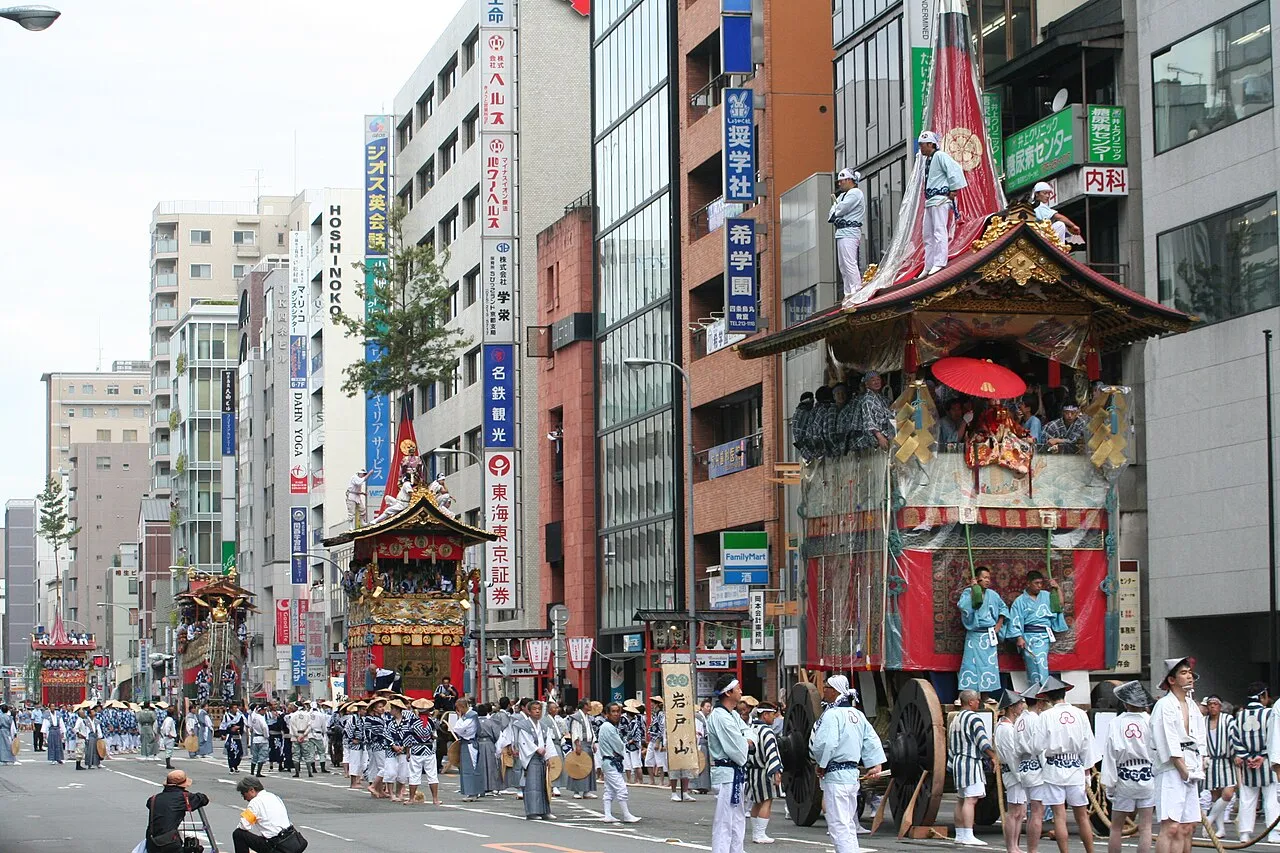
For visitors, two things stand out. On the evenings of July 15 and 16 the main streets close to cars and fill with lanterns, food stalls and festival music. Then on the parade days, 34 floats, the tallest about 25 meters to the tip of their spires and weighing up to about 12 tonnes, are pulled through central Kyoto by hand.
A festival for a storm god
The floats are not just decoration. They were built to gather up the spirits that caused disease and carry them out of the city. That is why the floats are taken apart right after each parade, and why the mikoshi carrying Susanoo spends a week downtown, among the people.
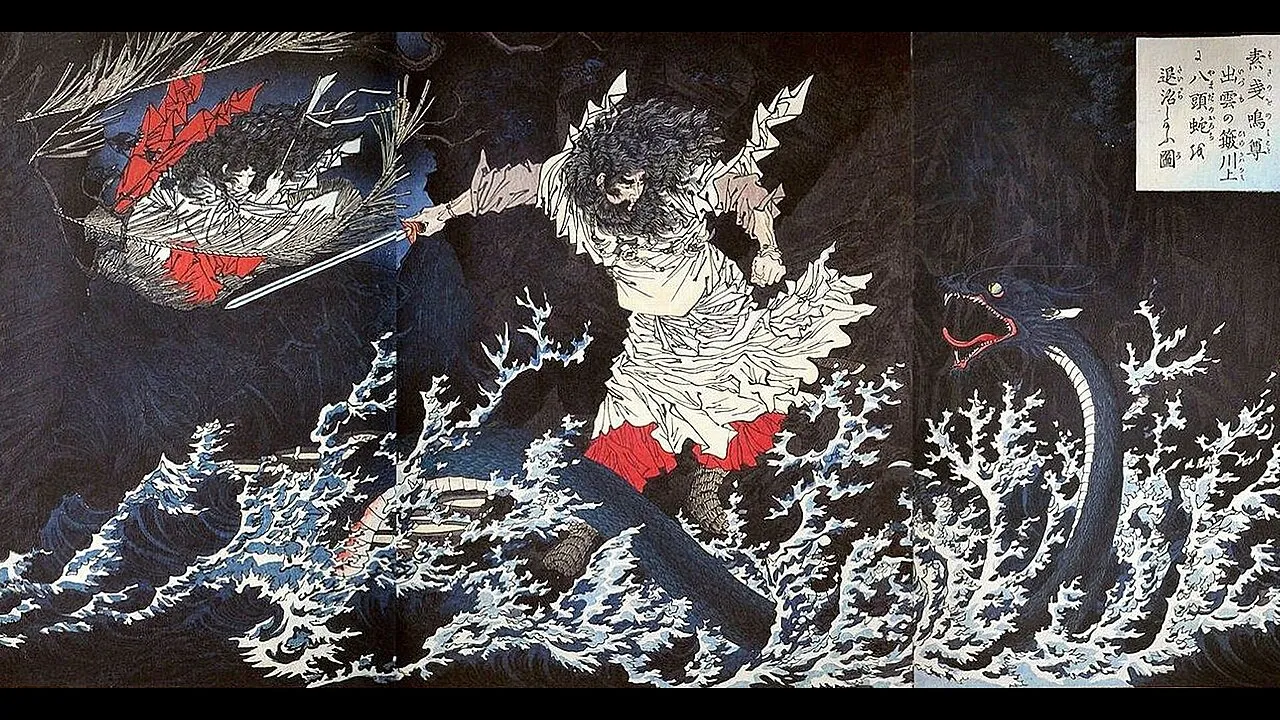 Kami of this festivalSusanooThe storm god who was thrown out of heaven, slew an eight-headed serpent, and is now the guardian at the center of Kyoto's Gion Matsuri. Read the story →
The festival at a glance
| Date | What happens |
|---|---|
| Jul 1 | Opening rituals: Ceremonies in the float neighborhoods |
| Jul 10 | Mikoshi-arai: A portable shrine is purified with river water at Shijō Bridge (evening) |
| Jul 14–16 | Yoiyama evenings: Floats lit with lanterns and festival music. Main streets are car-free with street stalls on Jul 15–16 |
| Jul 17 | Main parade and Shinkōsai: 23 floats from 9:00; mikoshi procession in the evening |
| Jul 21–23 | Second Yoiyama: Evenings before the second parade. Quieter, with no street stalls or car-free streets |
| Jul 24 | Second parade: 11 floats, the Hanagasa flower-hat procession, mikoshi return in the evening |
| Jul 31 | Closing purification: Walk through the grass ring at Eki Shrine |
Which day should you go?
Yoiyama evening, Jul 15 or 16
Walk among the lit floats after dark, hear the kon-chiki-chin music, eat from street stalls. Free, no tickets, and cooler than the daytime parade.
Main parade, Jul 17 morning
The full procession of 23 floats. Very hot and crowded. Arrive by 8:00 or book a paid seat.
Second parade, Jul 24
Smaller and calmer, with the Hanagasa procession of costumed dancers and flower hats the same morning.
Where the floats go
Schematic, not to scale. The floats start at Shijō-Karasuma, head east, then north, then west. At each corner crews turn the multi-tonne floats in place by sliding them over wet split bamboo: this is the tsuji-mawashi, the most exciting moment to watch. The second parade on Jul 24 starts at Karasuma-Oike and runs the loop the other way, ending at Shijō-Karasuma.
What to look for

Hoko and yama
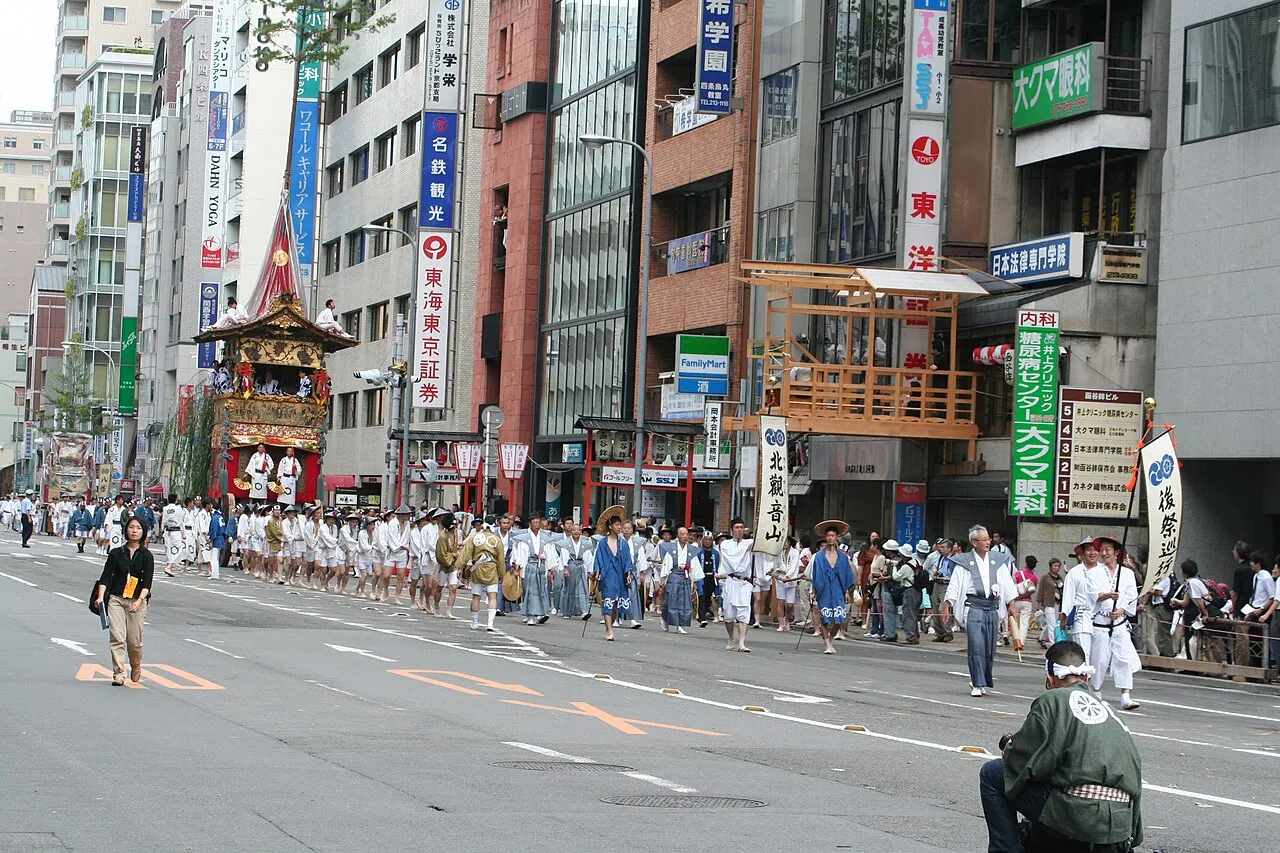
The tall floats with a spear-like pole are hoko, pulled by ropes and carrying musicians. The smaller yama are carried or pulled and topped with a pine tree and figures from legend.
The sacred child
A boy chosen as the chigo rides the lead float, Naginata-boko, and cuts a sacred rope stretched across Shijō Street at Fuyachō to open the parade.
The lot check
Parade order is drawn by lot each year. At Shijō-Sakaimachi, each float's lot is shown to an official dressed as a city magistrate.
Chimaki charms
Bamboo-leaf charms sold at each float during Yoiyama. Not food. Hang one by your door for protection.
Practical tips
- Heat. Kyoto in mid-July often passes 35 °C. Bring water, a hat and a hand fan.
- Getting there. Shijō Station (subway) and Karasuma Station (Hankyu) sit at the parade start. Kyoto-kawaramachi Station (Hankyu) is at the first turn.
- Paid seats. Reserved seats along Oike Street are sold in advance, mostly on Japanese-language sites.
- Manners. Do not touch the floats or cross the ropes. Some floats limit who may climb aboard during Yoiyama, so follow the signs.
- Crowds. On Jul 15 and 16, Shijō and Karasuma streets close to cars from early evening and police direct the crowd flow. Keep moving with the crowd and meet friends at a fixed landmark.
Glossary
Yamaboko山鉾
The general name for the Gion Matsuri floats, both the tall hoko and the smaller yama. Listed as UNESCO Intangible Cultural Heritage.
Yoiyama宵山
The festival evenings before a parade, when the floats stand lit in their neighborhoods.
Gion-bayashi祇園囃子
The festival music of flutes, drums and small gongs, often called kon-chiki-chin after its sound.
Tsuji-mawashi辻回し
Turning a float 90 degrees at a street corner by sliding it over wet split bamboo.
Chigo稚児
A child who serves as a sacred messenger of the kami during the festival.
Mikoshi神輿
A portable shrine. During the festival the kami rides inside while people carry it through the neighborhood.
Chimaki粽
At the Gion Matsuri, a bundle of bamboo leaves sold as a protective charm. It is not food; hang it by your door.
Make it part of your trip
References
- Kyoto City official tourism site (Kyoto Kanko Navi): Gion Matsuri overview and paid seating, https://ja.kyoto.travel/event/major/gion/
- Kyoto City official tourism site: Yamaboko parade times, route and lot checks, https://ja.kyoto.travel/event/single.php?event_id=6778
- Yasaka Shrine, official website: Gion Matsuri rituals (site unavailable on the check date; recheck).
- Sankei Shimbun via Yahoo! News: traffic controls and Yoiyama car-free streets.
- UNESCO: “Yama, Hoko, Yatai, float festivals in Japan” (2016).
Last checked 2026-10-12.