The story of the hidden sun
A goddess born from light
When the creator god Izanagi returns from the land of the dead, he washes himself in a river. Amaterasu is born as he washes his left eye, and she shines so brightly that he sends her to rule the heavens.
The cave
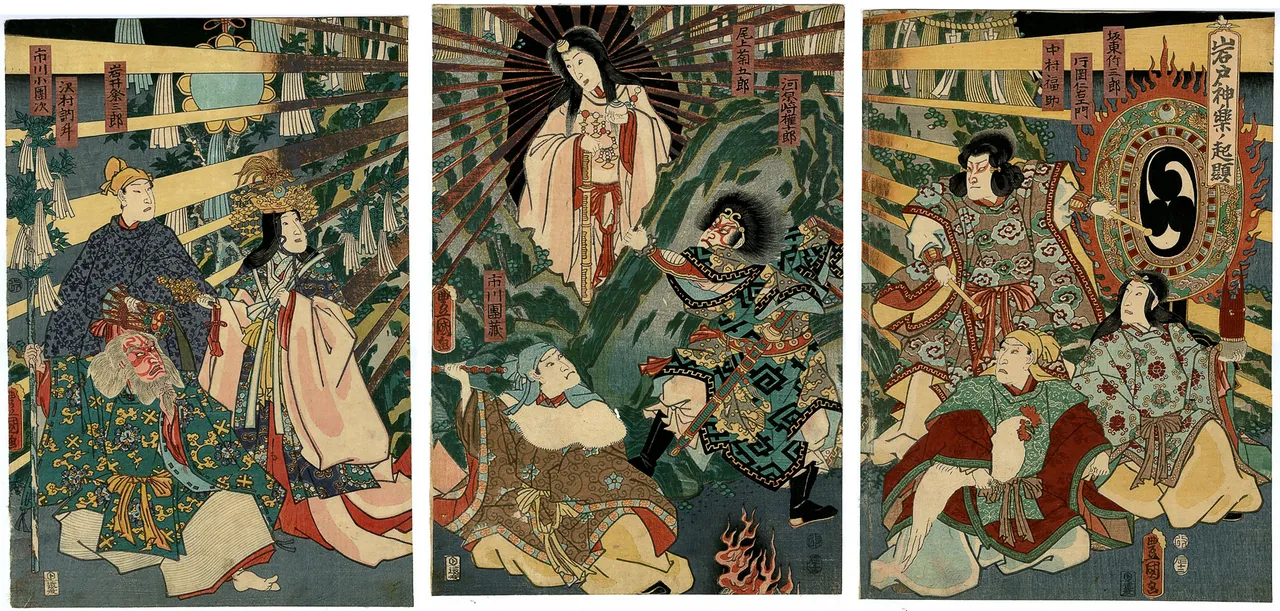
Her brother Susanoo storms through heaven, wrecking her rice fields and polluting her halls. When he throws a flayed horse into the hall where her maidens weave, Amaterasu hides inside the Heavenly Rock Cave, Ama-no-Iwato, and seals it with a boulder. The sun disappears. Crops fail and evil spirits roam in the dark.
The dance
Eight hundred gods gather outside the cave and make a plan. They hang a mirror and jewels on a sacred tree, set roosters crowing, and the goddess Ame-no-Uzume dances on an upturned tub. Her dance is so wild that the gods roar with laughter. Curious, Amaterasu opens the door a crack and sees her own brilliant reflection in the mirror. As she leans out, the strong god Tajikarao pulls her free, and a sacred rope is stretched across the cave so she cannot go back. Light returns to the world.
The ancestor of emperors
Later Amaterasu sends her grandson Ninigi down to rule Japan, giving him a mirror, a jewel and a sword. These are the three imperial regalia, and according to the myth the imperial family descends from him.
Where you’ll meet her
Ise Jingū in Mie Prefecture is Japan’s most sacred shrine. Its Inner Shrine, Naikū, is dedicated to Amaterasu and holds the sacred mirror, which no visitor ever sees. Every 20 years the shrine buildings are rebuilt on a neighboring plot in a ceremony called the Shikinen Sengū. The last rebuilding was in 2013 and the next is due in 2033.
The cave story lives on in kagura, sacred dance performed for the kami. In Takachiho, Miyazaki Prefecture, which claims the cave itself at Amano Iwato Shrine, villagers perform all-night yokagura in private homes from November to February. Visitors can watch a one-hour version every evening at Takachiho Shrine.
The rope at the cave mouth is also why you see shimenawa, thick ropes of rice straw, hung at shrines across Japan. They mark a boundary around something sacred.
Glossary
Kami神
A Shinto deity or sacred presence. Kami can be gods from myth, spirits of nature, or deified people.
Kagura神楽
Sacred music and dance performed for the kami. Many forms retell myths, above all the story of Amaterasu and the rock cave.
Shimenawa注連縄
A thick rope of rice straw, often hung with zigzag paper strips, that marks a sacred boundary at a shrine, a tree or a rock.
Kojiki古事記
Japan's oldest surviving book, compiled in 712. It records the myths of the kami.
Torii鳥居
The gate at the entrance to a shrine. Passing through it means stepping from the everyday world into a sacred space.
References
- Kojiki (712). English translation: Basil Hall Chamberlain, 1882.
- Nihon Shoki (720). English translation: W. G. Aston, 1896.
- Jingū Administration Office (Ise Jingū), official website: Naikū and the Shikinen Sengū.
- Takachiho Town Tourist Association: Takachiho yokagura.
Last checked 2026-10-12.