Who Hachiman is
Hachiman first appears at Usa in Kyushu, in what is now Ōita Prefecture. Over time he came to be identified with Emperor Ōjin, a legendary early ruler, and he is usually worshipped together with Ōjin’s mother, Empress Jingū, and a goddess called Hime-ōkami.
Hachiman was also one of the first kami to be honored in Buddhist terms. In the 8th century the court gave him the title Hachiman Daibosatsu, “Great Bodhisattva Hachiman”, after his oracle supported the building of the Great Buddha at Tōdai-ji in Nara.
Guardian of the samurai
The Minamoto clan, Japan’s most famous samurai family, adopted Hachiman as their protector. In 1063 Minamoto no Yoriyoshi founded a Hachiman shrine near Kamakura. When Minamoto no Yoritomo made Kamakura his capital in 1180, he moved it to the center of the city as Tsurugaoka Hachimangū. As samurai rule spread, so did Hachiman shrines.
Look up at the main gate of Tsurugaoka Hachimangū: the character 八 (hachi) on its plaque is drawn as a pair of doves, Hachiman’s messengers. That is why Kamakura’s best-known souvenir is a dove-shaped butter cookie.
Where you’ll meet him
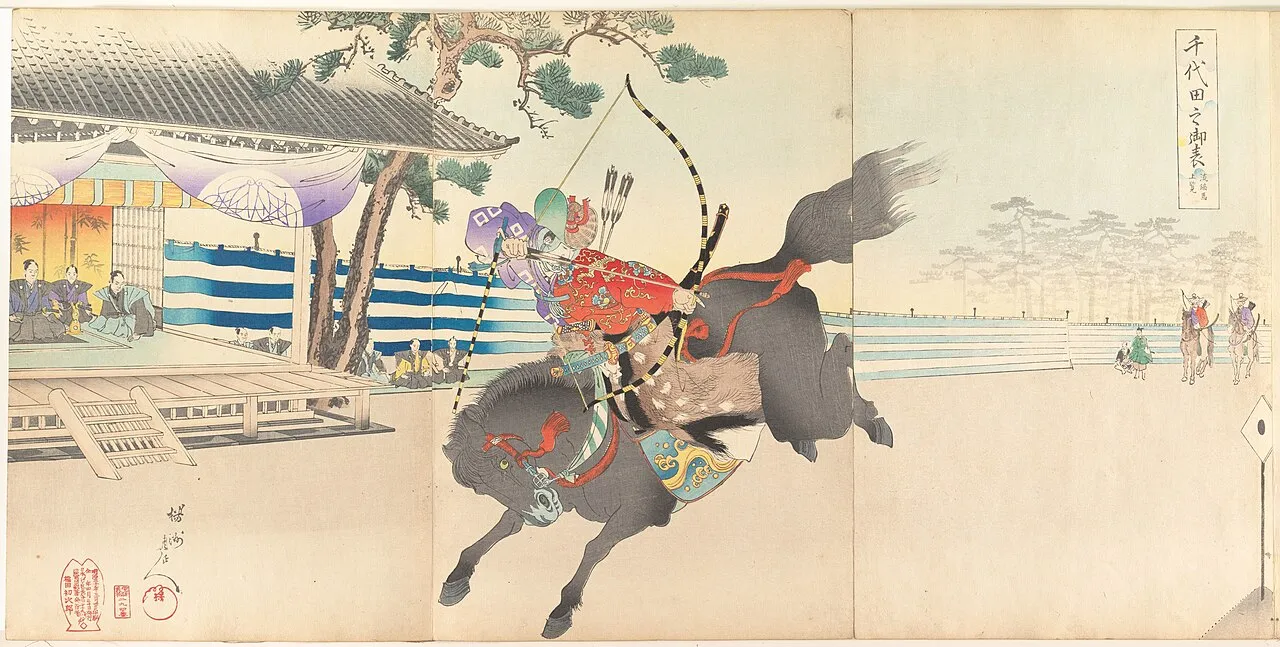
- Tsurugaoka Hachimangū, Kamakura (September 16): yabusame, mounted archery, as riders in hunting dress gallop down a track and shoot at wooden targets. It is the highlight of the shrine’s annual festival.
- Iwashimizu Hachimangū, Kyoto (September 15): the Iwashimizu-sai, a night procession that begins in the early hours and includes the ritual release of fish and birds.
- Hakozaki-gū, Fukuoka (September 12–18): the Hōjō-ya festival, with hundreds of street stalls along the approach to the shrine.
Many local autumn festivals across Japan are also held for Hachiman, since he is the guardian kami of countless neighborhoods.
Glossary
Kami神
A Shinto deity or sacred presence. Kami can be gods from myth, spirits of nature, or deified people.
Yabusame流鏑馬
Mounted archery, in which a rider at full gallop shoots arrows at wooden targets beside a track. It is performed as an offering to the kami.
Torii鳥居
The gate at the entrance to a shrine. Passing through it means stepping from the everyday world into a sacred space.
Omamoriお守り
A small cloth charm sold at shrines and temples for protection, health, safe travel or success. Keep it closed and carry it with you.
References
- Usa Jingū, official website: history and deities.
- Tsurugaoka Hachimangū, official website: history and annual festivals.
- Iwashimizu Hachimangū, official website: Iwashimizu-sai.
- Kokugakuin University, Encyclopedia of Shinto: “Hachiman shinkō”.
Last checked 2026-10-12.