
Three scenes from the myth
Born from a sword
When the creator god Izanagi cut down the fire god whose birth had killed his wife, the blood that ran down his sword gave birth to new gods. One of them was Takemikazuchi, whose name is linked with ikazuchi, thunder. From the start he belonged to the sword and the lightning flash.
The transfer of the land
The gods of heaven, led by the sun goddess Amaterasu, decided that the land below should be ruled by her descendants. It was then held by Ōkuninushi, lord of Izumo. Messengers were sent and failed. Finally Takemikazuchi went down to the beach of Inasa in Izumo, thrust his sword upright into the crest of a wave and sat cross-legged on its point.
Ōkuninushi’s son Kotoshironushi agreed to hand over the land. His other son, Takeminakata, challenged Takemikazuchi to a trial of strength, lost, and fled to Suwa in Nagano. Ōkuninushi gave up the land, and the way was opened for the imperial line.
The white deer
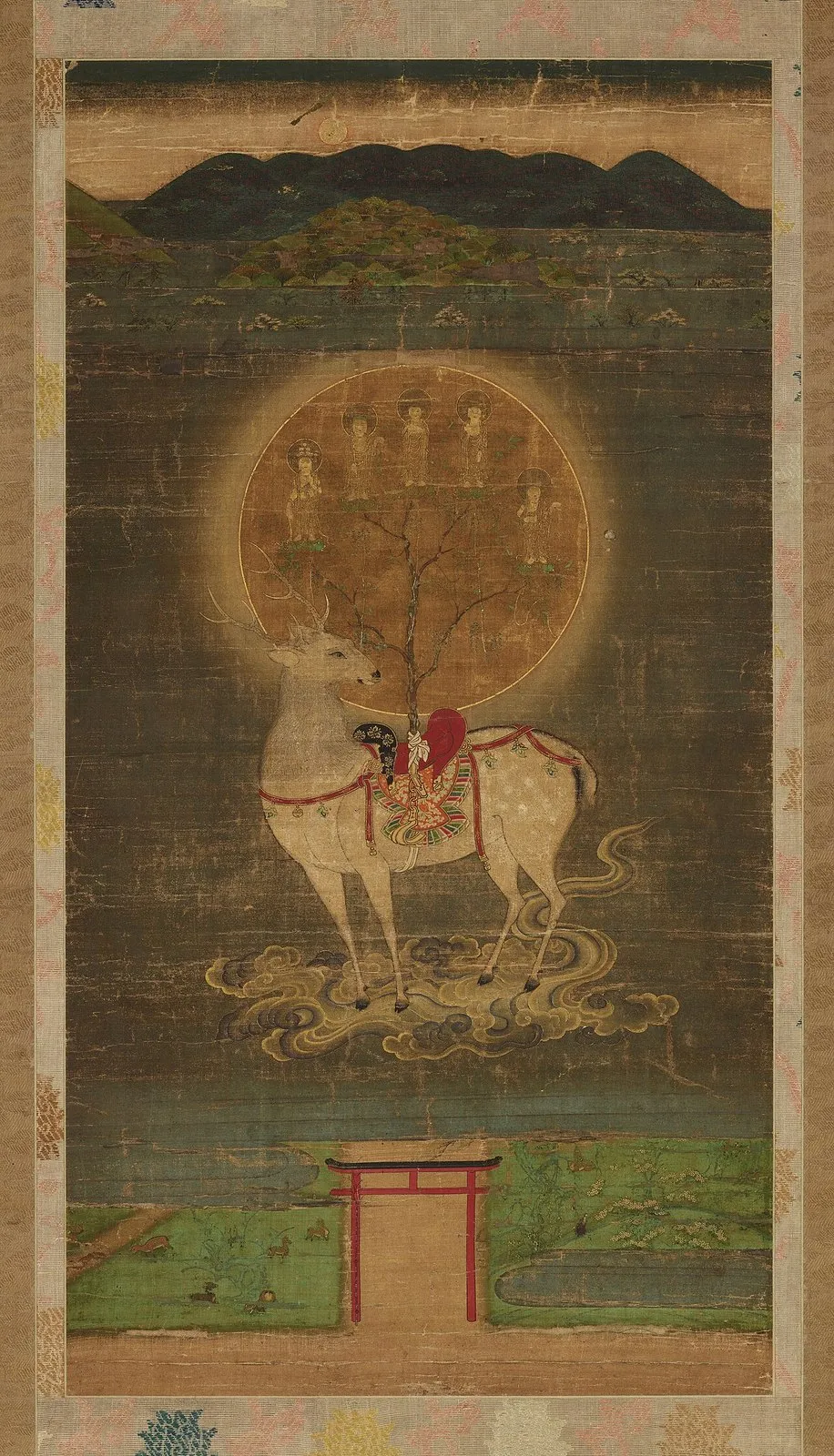
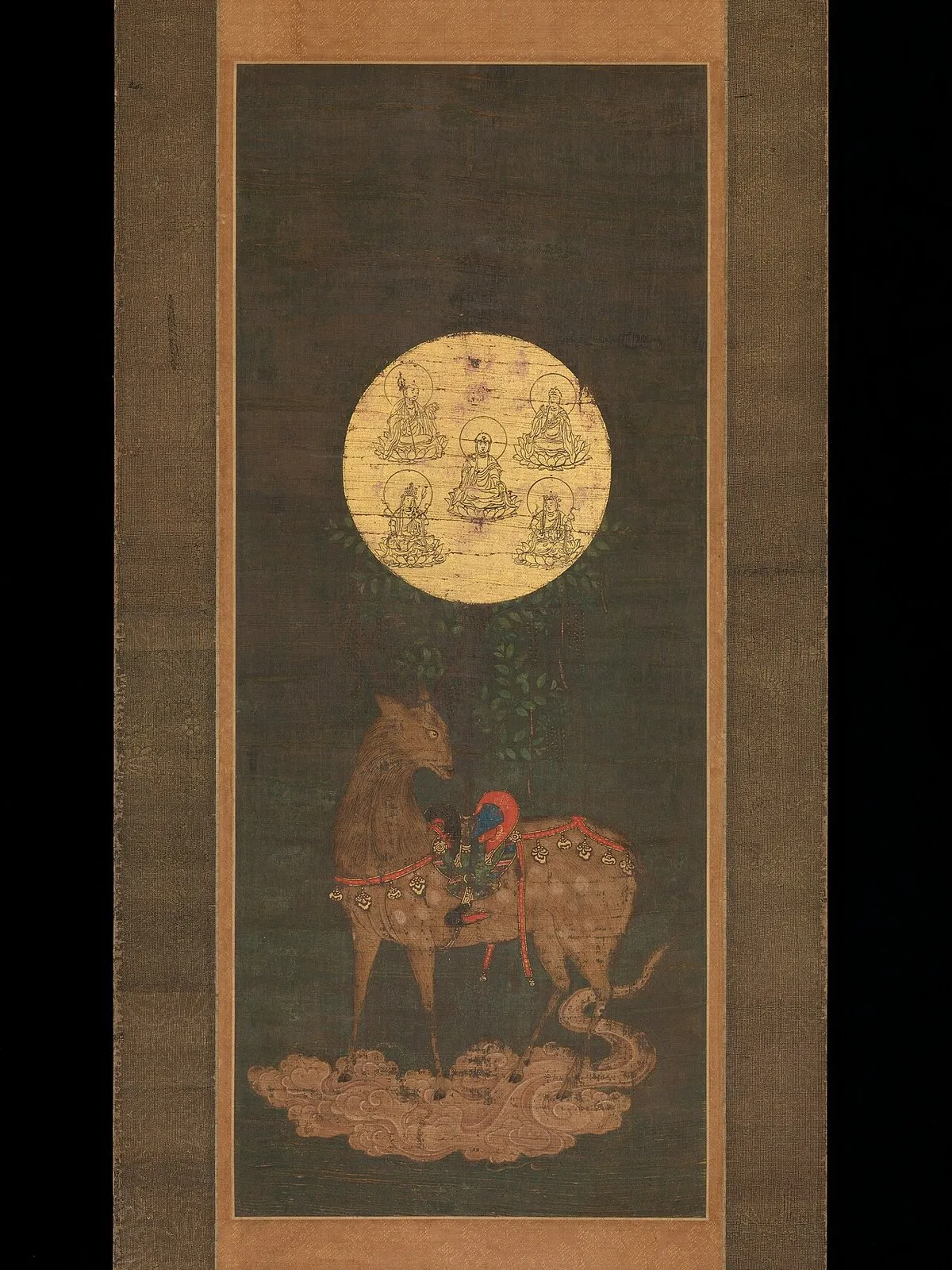
Takemikazuchi is worshipped at Kashima Jingū on the coast east of Tokyo, one of the oldest shrines in eastern Japan. Early in the Nara period, to protect the new capital, he was invited from Kashima to the top of Mount Mikasa in Nara, and legend says he arrived riding a white deer. In 768 the shrine buildings of Kasuga Taisha were raised at the foot of the mountain, with Takemikazuchi in the first of its four sanctuaries. The deer of Nara Park are treated as his messengers to this day.
Why he matters for festivals
As the god who won the land with his sword, Takemikazuchi became a patron of warriors and martial arts. Many dojo hang a scroll with his name. At Kashima Jingū he is also said to hold down the giant catfish that causes earthquakes, pinning its head with the kaname-ishi, a stone whose top just shows above the ground. A matching stone at nearby Katori Jingū, the shrine of his companion Futsunushi, holds the tail.
You can meet him at the Kashima Saitōsai in March, when costumed teams parade with long staffs, and at the Kasuga Matsuri in Nara on March 13, one of the three great festivals attended by an imperial envoy.
Festivals
Saitosai at Kashima Jingū
Kashima Jingū and central KashimaMarch 9 and the following Saturday★★ Day trip. About 2 hours from Tokyo Station by highway bus to Kashima Jingū, or by JR to Kashimajingū Station.Kasuga Matsuri
Kasuga Taisha Shrine, NaraMarch 13★★ Day trip. Day trip from Kyoto or Osaka. Kasuga Taisha is about 30 minutes on foot or a short bus ride from Kintetsu-Nara Station.
Glossary
Kami神
A Shinto deity or sacred presence. Kami can be gods from myth, spirits of nature, or deified people.
Kojiki古事記
Japan's oldest surviving book, compiled in 712. It records the myths of the kami.
Matsuri祭り
A Japanese festival, usually held for the kami of a local shrine. The word comes from the idea of serving and entertaining the gods.
References
- Kojiki (712). English translation: Basil Hall Chamberlain, 1882.
- Nihon Shoki (720). English translation: W. G. Aston, 1896.
- Kashima Jingū and Kasuga Taisha: shrine histories and deities.
- Kokugakuin University, Encyclopedia of Shinto: “Takemikazuchi”, “Kasuga shinkō”.
- Katori Jingū: the kaname-ishi.
Last checked 2026-10-15.