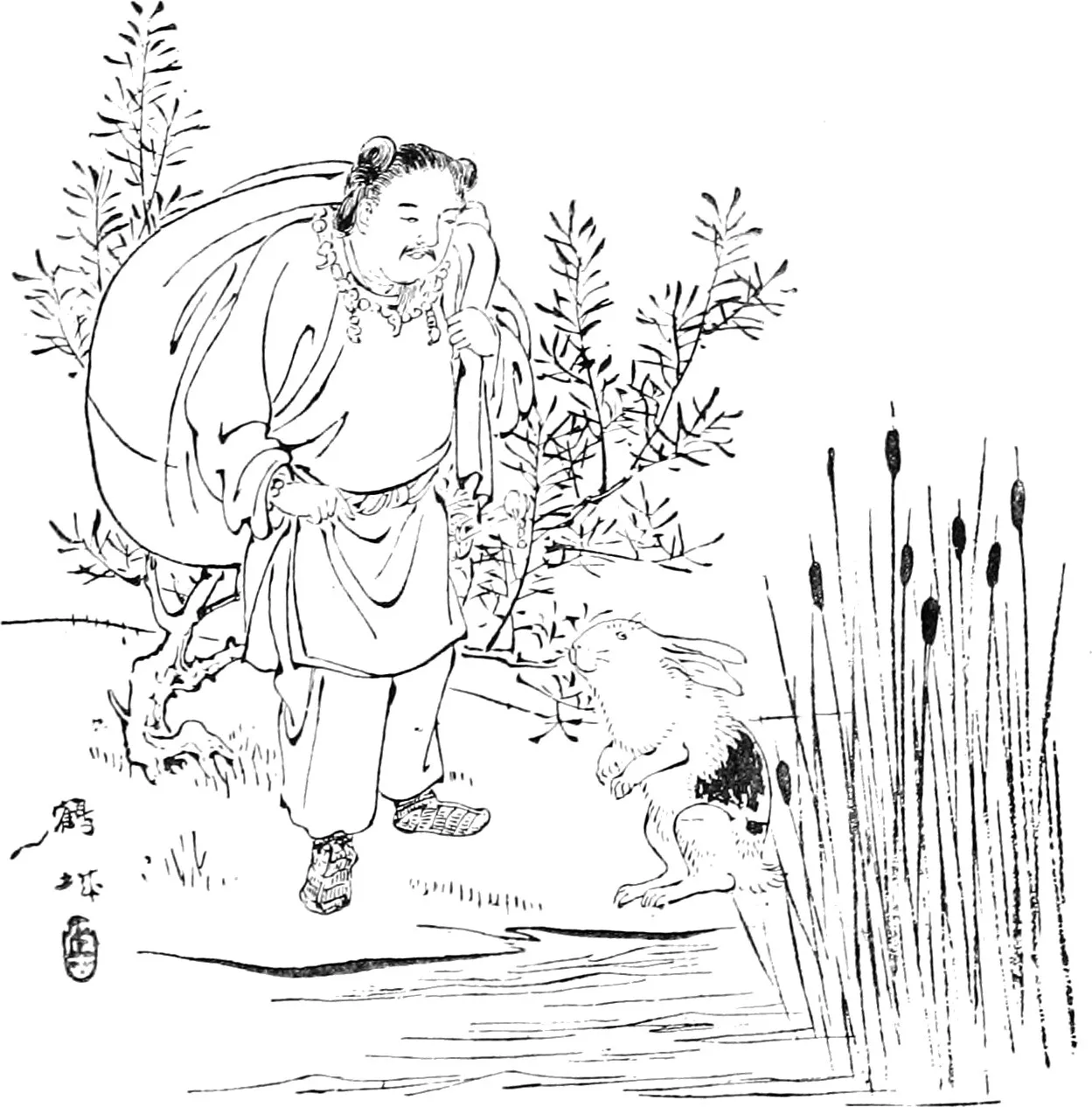
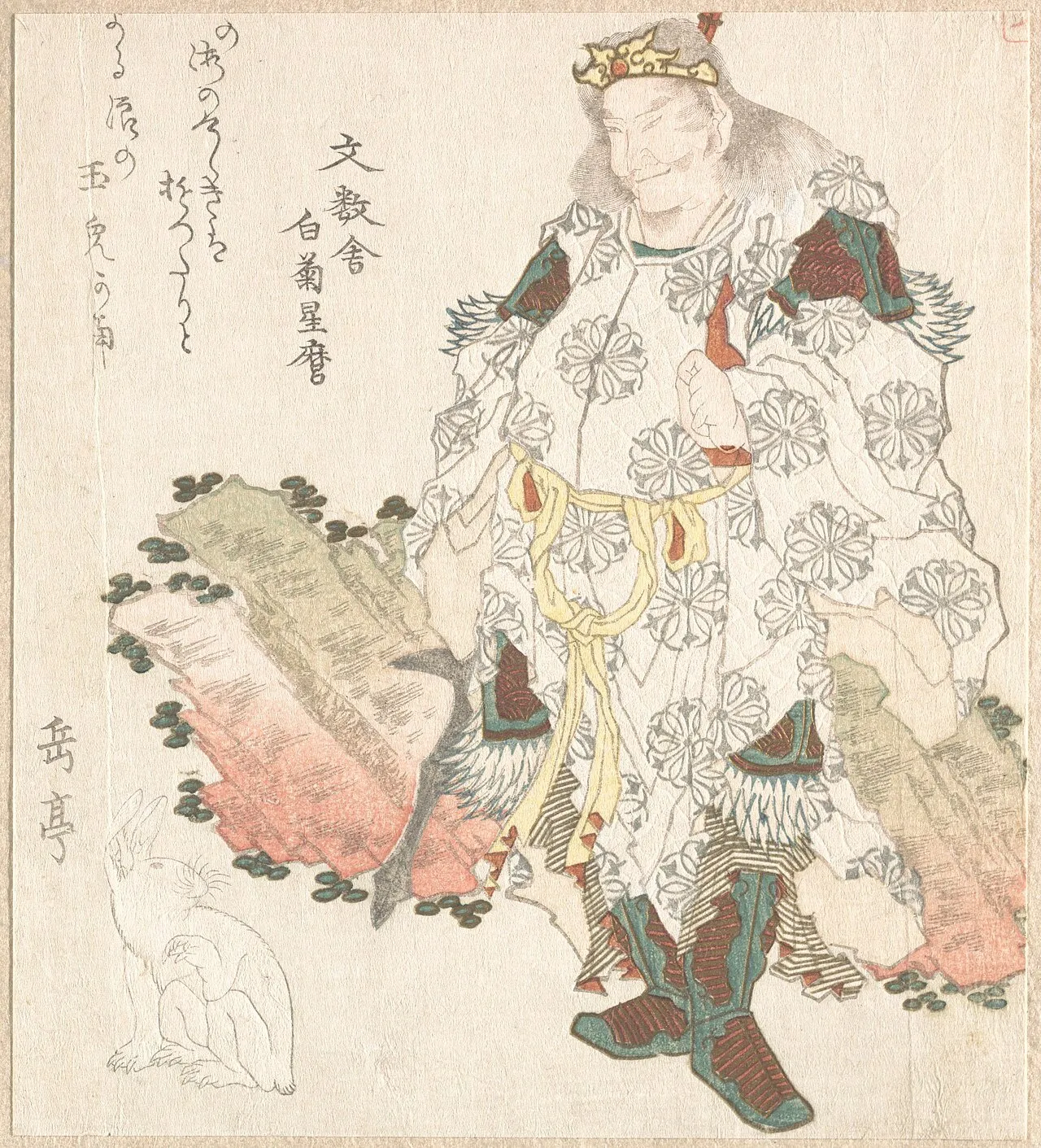

Four scenes from the myth
The White Hare of Inaba
Ōkuninushi, then called Ōnamuchi, had many older brothers, who made him carry their bags as they travelled to woo a princess in Inaba. On the way they met a hare that had been skinned by sea creatures it had tricked. The brothers told it to bathe in sea water and dry in the wind, and it was left in agony. Ōnamuchi, coming last, told it to wash in fresh water and roll in the pollen of cattails, and the hare was healed. The hare foretold that the princess would choose him, and she did.
Death and the underworld
The jealous brothers killed him twice, once with a burning boulder disguised as a boar and once by crushing him in a tree, and twice his mother had him brought back to life. He fled to the underworld, the Land of Roots, where Susanoo lived. There he fell in love with Susanoo’s daughter, Suseri-hime. Susanoo tested him by making him sleep in a room of snakes and a room of centipedes and wasps, and by setting a field on fire around him. Suseri-hime’s magic scarves and a helpful mouse saved him. At last he escaped with his bride and Susanoo’s sword, bow and harp, and Susanoo shouted after him to become Ōkuninushi, “Great Lord of the Land”.
Building the land
With a tiny god, Sukunabikona, who came over the sea in a boat made from a seed pod, Ōkuninushi made the land fit to live in, teaching people farming and medicine. When Sukunabikona left for the land beyond the sea, another god came across the sea, shining over the water, and offered to help him finish the work if he was worshipped on Mount Miwa.
Giving it away
When the gods of heaven sent Takemikazuchi to claim the land for the descendants of Amaterasu, Ōkuninushi agreed to give it up, asking only for a great palace in Izumo. That palace is said to be Izumo Taisha, the great shrine of Izumo.
Why he matters for festivals
Ōkuninushi rules over unseen things, among them the ties between people. In the tenth month of the old calendar, the gods of all Japan are said to gather at Izumo Taisha to decide the coming year’s matches and fortunes. Elsewhere it is called Kannazuki, “the month without gods”; in Izumo it is Kamiarizuki, “the month with gods”. This is why Izumo Taisha is the place to pray for love and good relationships.
He is also widely known as Daikoku-sama, because the characters for his name can be read Daikoku, the name of a Buddhist god of plenty. As Daikoku he is the first deity of Kanda Myōjin in Tokyo, whose Kanda Matsuri fills the city with mikoshi every other May.
Festivals
Kanda Matsuri
Kanda Myōjin Shrine and central TokyoMid-May in odd-numbered years★ Easy access. Kanda Myōjin is about 5 minutes on foot from Ochanomizu Station or 7 minutes from Akihabara Station.
Glossary
Kami神
A Shinto deity or sacred presence. Kami can be gods from myth, spirits of nature, or deified people.
Kojiki古事記
Japan's oldest surviving book, compiled in 712. It records the myths of the kami.
Matsuri祭り
A Japanese festival, usually held for the kami of a local shrine. The word comes from the idea of serving and entertaining the gods.
Omamoriお守り
A small cloth charm sold at shrines and temples for protection, health, safe travel or success. Keep it closed and carry it with you.
References
- Kojiki (712). English translation: Basil Hall Chamberlain, 1882.
- Izumo Taisha: deities, Kamiari-sai.
- Kanda Myōjin: deities (Ōnamuchi as Daikoku-sama).
- Tottori City: the White Hare of Inaba.
- Kokugakuin University, Kojiki commentary: nation-building with Sukunabikona.
Last checked 2026-10-15.